What the brand says and what research shows
How Zeaxan Works: Pigments, Panel and Routine
Zeaxan is built around a daily routine: follow the label, take the formula, and keep a steady habit.
Two of its ingredients, lutein and zeaxanthin, form macular pigment in the eye. AREDS2 used 10 mg lutein and 2 mg zeaxanthin a day.
For the rest of the formula, see the full ingredient list.
How does Zeaxan work?
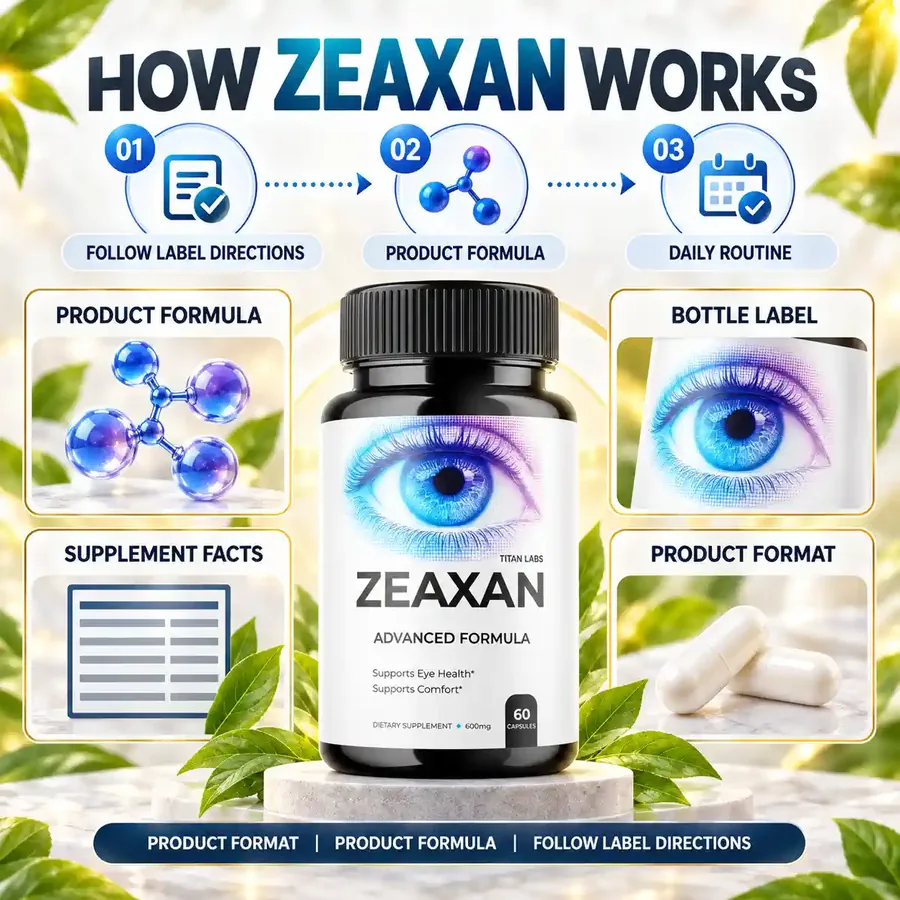
The maker has not published a mechanism or a study for the Zeaxan formula. Its "How Zeaxan works" panel names three things: follow the label directions, the product formula, and a daily routine.
That panel describes how to use the product, not what it does inside the body. Below, the brand wording is quoted first. After that come the most studied ingredients and what research on them has and has not found, in general terms.
Follow label directions
2 capsules a day between meals, as printed on the side of the bottle.
Product formula
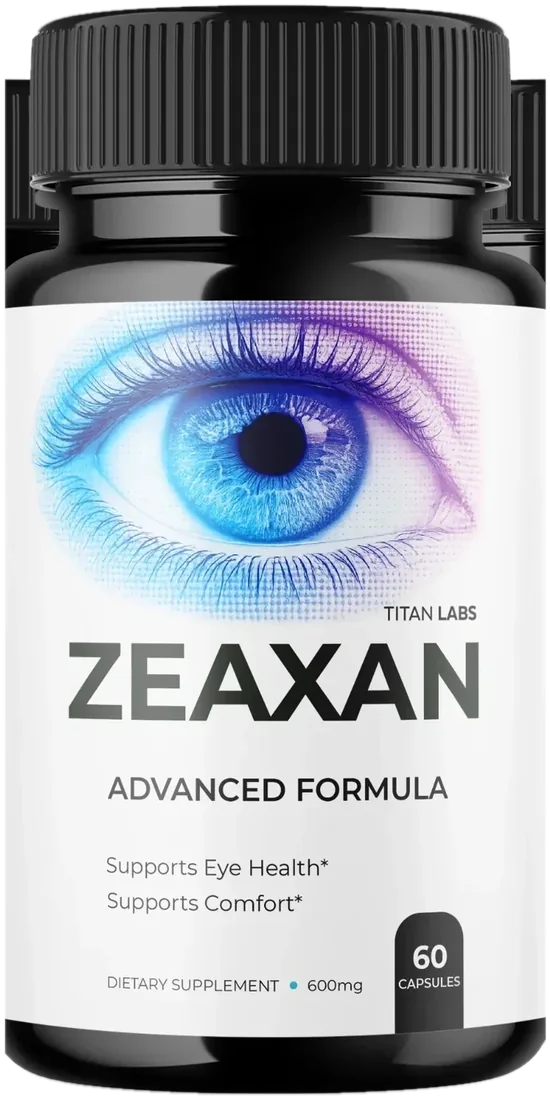
One 600 mg blend of 11 ingredients, with no single amounts printed.
Daily routine
Take it every day at a steady time. The panel does not describe any effect.
Is there a study on Zeaxan itself?
No study on the finished Zeaxan capsule has been published that we can find. The label and brand panels do not mention one either.
This matters because a blend is not the same as its parts. Research on one ingredient, at one dose, in one group of people, does not tell you what a mix of 11 ingredients will do. That is even more true when the amounts are not printed. The front label lines "Supports Eye Health" and "Supports Comfort" carry an asterisk. It points to the standard FDA statement, which says the claims have not been evaluated by the FDA (FDA).
What are lutein and zeaxanthin?
Lutein and zeaxanthin are yellow pigments from a family called carotenoids. The body cannot make them, so they come from food, mainly dark leafy greens, eggs, corn and orange or yellow peppers.
In the eye, these two pigments gather in the macula. The macula is a small area at the center of the retina that handles fine, straight-ahead detail. Together, the pigments there are called macular pigment. They absorb some blue light, and they act as antioxidants in the tissue. That is a description of where they sit and what they do in general. It is not a claim about what a capsule will do for you.
Our lutein and zeaxanthin guide covers food sources and how the pigments are measured. The everyday eye health guide covers daily habits.
What did the AREDS2 study find?
AREDS2 was a large National Eye Institute study. It tested a formula with 10 mg of lutein and 2 mg of zeaxanthin a day, plus other nutrients, in people who already had intermediate age-related macular degeneration (NEI).
Two points set expectations. First, the study group had a diagnosed eye condition. Second, the NEI says the original AREDS formula showed no benefit for people without AMD or with early AMD. So the research does not show that lutein or zeaxanthin helps healthy eyes.
Zeaxan is not the AREDS2 formula. It prints no amounts. If its 5% markings mean 5% pure pigment, a serving holds at most about 6 mg of lutein and 3 mg of zeaxanthin. The real amounts could be lower. It also lacks the other AREDS2 nutrients. The ingredients page shows how those ceilings are worked out.
What about the other ingredients?
Most of the other ingredients have no strong research link to the eye. Some have been studied for other things, and some have been studied and found wanting.
| Ingredient | What it is | What research says |
|---|---|---|
| Lutein (5%) | A yellow carotenoid found in leafy greens. It collects in the macula as part of macular pigment. | AREDS2 used 10 mg a day in people with intermediate AMD. |
| Zeaxanthin (5%) | A close cousin of lutein, found in corn and orange peppers. It is also part of macular pigment. | AREDS2 used 2 mg a day in the same group. |
| Bilberry Leaf Powder | A leaf powder from the bilberry shrub, not the berry. | Rigorous studies found bilberry fruit extracts did not improve night vision in healthy people. |
| Bacopa Monnieri (20%) | An herb used in traditional Indian medicine. | Research looks at memory and processing speed, not eyes. |
| Ginkgo Biloba Powder | Leaf material from the ginkgo tree. The label spells it "Gingko". | No conclusive evidence it helps any condition. |
| Vitamins B6 and B12 | Water-soluble vitamins the body uses every day. | Amounts are not printed, so their role here cannot be judged. |
Bacopa is a good example. A review of nine trials found small gains in processing speed after 12 weeks or more of a standardized extract (Kongkeaw et al., 2014). That is a memory and thinking finding. It says nothing about eyes. For bilberry, NCCIH says rigorous studies found it did not improve night vision in healthy people (NCCIH, 2024). Zeaxan uses the leaf, which is less studied still.
The largest single ingredient by weight is Himalayan pink salt, which is not an eye nutrient. Cinnamon, second, has no clear research support for any condition (NCCIH, 2024).
How can you judge an eye supplement claim?
Ask where the claim comes from and who was studied. A quick check of the label and the source takes a few minutes and saves a lot of guesswork.
Find the amount
Look for the milligrams of each ingredient. Zeaxan prints only the 600 mg blend total, so you can only work out ceilings.
Match the dose to research
Compare the amount with the dose used in studies, such as 10 mg of lutein and 2 mg of zeaxanthin in AREDS2.
Check who was studied
A result in people with intermediate AMD does not carry over to people with healthy eyes.
Read the asterisk
An asterisk on a claim points to the FDA statement. It means the claim was not evaluated by the FDA.
The NIH Office of Dietary Supplements has a plain guide to judging any product (NIH ODS).
So what can a daily routine do?
A daily routine makes sure you take the product the way the label says. It does not create an effect by itself, and the brand does not describe one.
- The label sets the dose: 2 capsules a day between meals
- The brand panel asks for daily, consistent use
- No published study sets a time frame for this formula
- Order-desk reviewers mostly say they waited 4 to 8 weeks before judging it
Food still matters. Leafy greens, eggs and colorful vegetables supply lutein and zeaxanthin in everyday meals. Not smoking, wearing sunglasses outdoors and getting regular dilated eye exams are habits eye care groups often point to.
If you notice blurry vision, eye pain, flashes, floaters or any sudden change in how you see, book an eye exam. A supplement cannot find or fix the cause. Before you start any new capsule, check the side effects page for ingredient interactions.
How Zeaxan works: common questions
Does Zeaxan improve eyesight?
No evidence shows that. No study on the formula has been published, and this site makes no vision claims.
What is macular pigment?
It is the layer of lutein, zeaxanthin and a related pigment in the macula, the center of the retina. It absorbs some blue light.
Can I get lutein and zeaxanthin from food?
Yes. Kale, spinach, collard greens, eggs, corn and orange peppers are common sources.
Is Zeaxan the same as an AREDS2 supplement?
No. AREDS2 used set amounts of several nutrients in people with intermediate AMD. Zeaxan has a different mix and prints no amounts.
Why is bacopa in an eye formula?
The label does not say. Bacopa research is about memory and processing speed, not eyes.
How long before Zeaxan works?
There is no published timeline. Most order-desk reviewers said they waited 4 to 8 weeks before judging it. Results vary.
Sources for this page
- National Eye Institute. About AREDS and AREDS2. Source
- Kongkeaw C, Dilokthornsakul P, Thanarangsarit P, Limpeanchob N, Scholfield CN. Meta-analysis of randomized controlled trials on cognitive effects of Bacopa monnieri extract. J Ethnopharmacol, 2014. Source
- National Center for Complementary and Integrative Health. Bilberry: Usefulness and Safety. Updated November 2024. Source
- National Center for Complementary and Integrative Health. Cinnamon: Usefulness and Safety. Updated November 2024. Source
- National Center for Complementary and Integrative Health. Ginkgo: Usefulness and Safety. Updated February 2025. Source
- U.S. Food and Drug Administration. Dietary Supplements. Source
- NIH Office of Dietary Supplements. Dietary Supplements: What You Need to Know. Source
Keep reading
Ready when you are
Order Zeaxan from the authorized US retailer
60 capsules in every bottle, 2 capsules a day. 60-day money-back guarantee. A real person at the order desk handles tracking, changes and refunds; the number is in the footer.