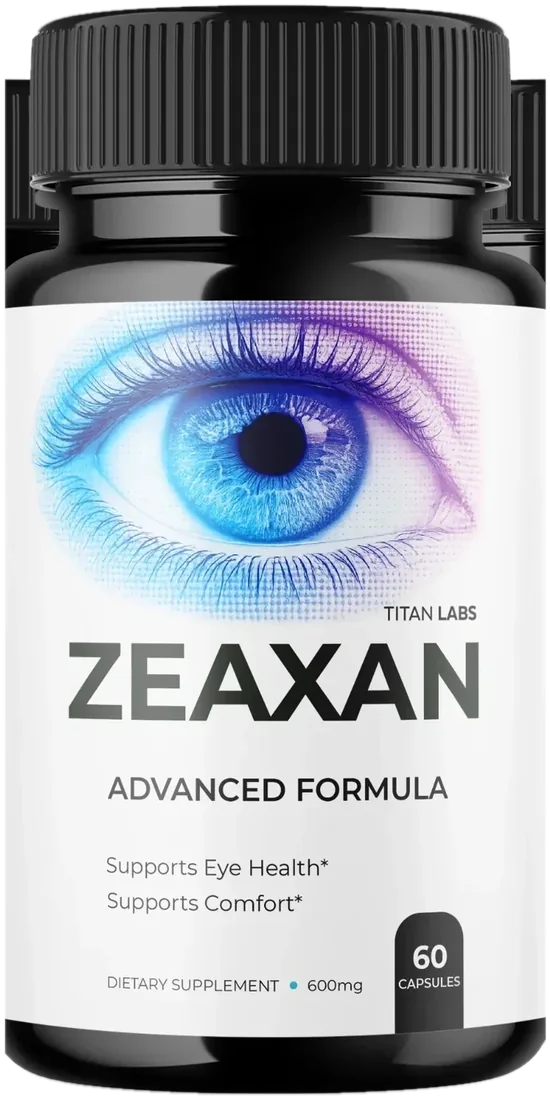
Read from the Supplement Facts panel
Zeaxan Ingredients in Label Order
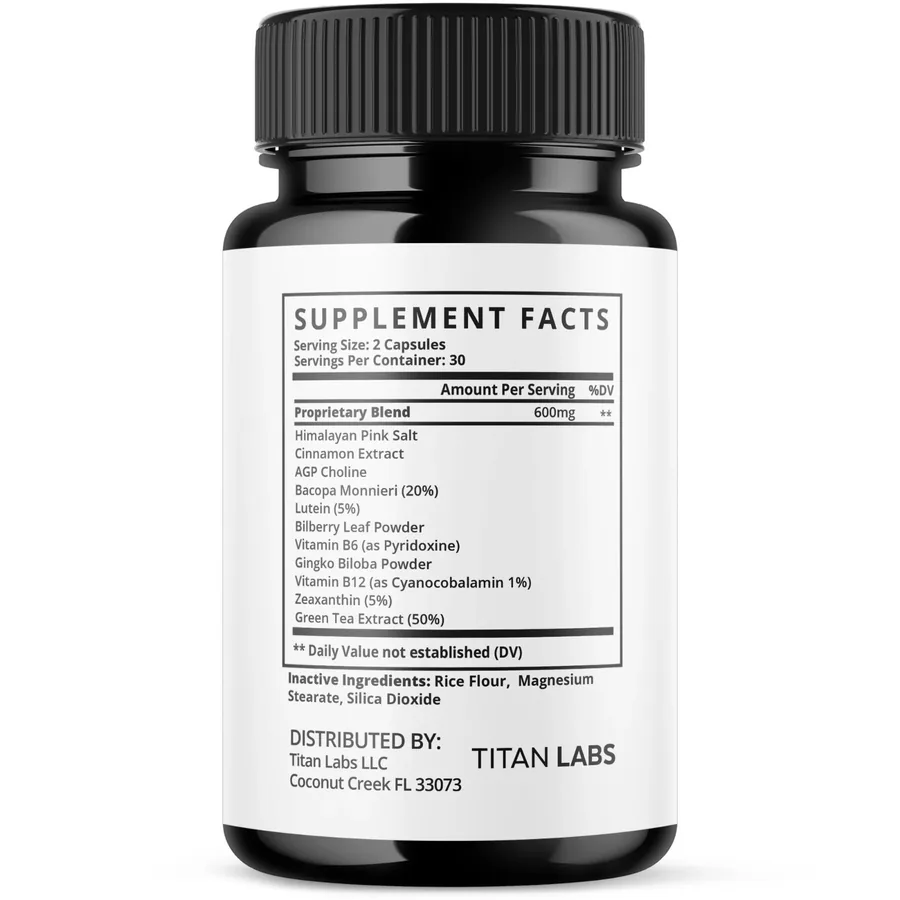
Each 2-capsule serving of Zeaxan holds 11 ingredients in one 600 mg blend.
Himalayan pink salt is listed first, so it weighs the most. Lutein is 5th and zeaxanthin 10th. Rice flour, magnesium stearate and silica dioxide are the inactive ingredients.
Next, read the panel line by line.
What ingredients are in Zeaxan?
Zeaxan lists 11 ingredients inside one 600 mg proprietary blend per 2-capsule serving. Three inactive ingredients hold the powder together in the capsule.
The label gives the total weight of the blend, not the weight of any single ingredient. You can read the full panel line by line on our Supplement Facts page.
11 blend ingredients
Salt, cinnamon, choline, bacopa, lutein, bilberry leaf, B6, ginkgo, B12, zeaxanthin and green tea extract.
600 mg shared total
All 11 split this one number for each 2-capsule serving. No single amount is printed.
3 inactive ingredients
Rice flour, magnesium stearate and silica dioxide. The capsule shell is not named.
All 11 Zeaxan ingredients in label order
Here is each ingredient in label order, with a note on the label and on published research.
1. Himalayan Pink Salt
On the label: Listed first, so by weight it is the largest single part of the blend. Ceiling: 600 mg.
What research says: Salt is not studied as an eye nutrient; it adds a little sodium to each serving. Source: NIH.
2. Cinnamon Extract
On the label: Second in the blend; the label does not say which cinnamon. Ceiling: 300 mg.
What research says: NCCIH says research does not clearly support cinnamon for any health condition (NCCIH, 2024).
3. AGP Choline
On the label: The label spells it 'AGP Choline'; it most likely means alpha-GPC, a choline source. Ceiling: 200 mg.
What research says: Men need about 550 mg of choline a day from all sources; the upper limit is 3,500 mg (NIH ODS).
4. Bacopa Monnieri (20%)
On the label: The 20% most likely marks a standardized extract; the label does not say of what. Ceiling: 150 mg.
What research says: Nine trials of standardized extract, taken 12 weeks or more, found small gains in processing speed (Kongkeaw et al., 2014).
5. Lutein (5%)
On the label: The eye pigment most people expect here. The 5% likely means a 5% extract. Ceiling: 120 mg.
What research says: The AREDS2 formula used 10 mg of lutein a day, in people with intermediate AMD (NEI).
6. Bilberry Leaf Powder
On the label: Leaf, not the berry most studies use. Ceiling: 100 mg.
What research says: Rigorous studies have not found bilberry improves night vision; leaves may be unsafe in high doses (NCCIH, 2024).
7. Vitamin B6 (as pyridoxine)
On the label: Printed with no amount or % Daily Value. Ceiling: 86 mg.
What research says: Men need 1.3 to 1.7 mg a day; long use of high doses can harm nerves; the upper limit is 100 mg (NIH ODS, 2023).
8. Ginkgo Biloba Powder
On the label: The label spells it 'Gingko'. It does not say leaf or extract. Ceiling: 75 mg.
What research says: No conclusive evidence ginkgo helps any condition; it may raise bleeding risk with blood thinners (NCCIH, 2025).
9. Vitamin B12 (as cyanocobalamin 1%)
On the label: A 1% form, diluted on a carrier; no amount printed. Ceiling: 67 mg.
What research says: Men need 2.4 mcg a day; no upper limit is set for B12 (NIH ODS).
10. Zeaxanthin (5%)
On the label: The ingredient in the name, tenth of eleven in the blend. Ceiling: 60 mg.
What research says: The AREDS2 formula used 2 mg of zeaxanthin a day, in people with intermediate AMD (NEI).
11. Green Tea Extract (50%)
On the label: Listed last, so it is the smallest share of the blend. Ceiling: 55 mg.
What research says: Rare liver injury has been linked to green tea extract capsules (NCCIH, 2025).
Note that salt comes first and zeaxanthin, the name on the bottle, is tenth. Our post on why salt is listed first looks at that choice in more depth.
How much of each ingredient can be in a serving?
Nobody outside the maker knows the real amounts, because they are not printed. You can still work out the most each one could be, using a simple labeling rule.
US rules say a proprietary blend must list ingredients from most to least by weight. So the second item can never be more than half the blend. The third can never be more than a third, and so on. Divide 600 mg by the position number and you get a ceiling.
| Ingredient (label order) | Marking | Most it can be per 2 capsules |
|---|---|---|
| 1. Himalayan Pink Salt | None | Up to 600 mg |
| 2. Cinnamon Extract | None | Up to 300 mg |
| 3. AGP Choline | None | Up to 200 mg |
| 4. Bacopa Monnieri (20%) | 20% | Up to 150 mg |
| 5. Lutein (5%) | 5% | Up to 120 mg |
| 6. Bilberry Leaf Powder | None | Up to 100 mg |
| 7. Vitamin B6 (as pyridoxine) | None | Up to 86 mg |
| 8. Ginkgo Biloba Powder | None | Up to 75 mg |
| 9. Vitamin B12 (as cyanocobalamin 1%) | 1% | Up to 67 mg |
| 10. Zeaxanthin (5%) | 5% | Up to 60 mg |
| 11. Green Tea Extract (50%) | 50% | Up to 55 mg |
All 11 have to fit inside the same 600 mg. If salt takes a large share, the rest get much less than their ceilings. Salt also has a floor of 55 mg, since it must outweigh each of the other ten.
What do the 5%, 20%, 50% and 1% markings mean?
The label does not explain them. The most likely reading is that they describe standardized ingredient materials, for example a lutein material that is 5% lutein by weight.
If that reading is right, the numbers change a lot. The lutein line could hold at most 120 mg of material, which would be about 6 mg of lutein at most. The zeaxanthin line could hold at most 60 mg of material, which would be about 3 mg of zeaxanthin at most. Both are upper limits built on an "if".
How do the ceilings compare with research amounts?
For lutein and zeaxanthin, the most cited research is the AREDS2 study run by the National Eye Institute. It sets a useful yardstick, with limits.
The AREDS2 formula used 10 mg of lutein and 2 mg of zeaxanthin a day, together with other nutrients, in people who already had intermediate age-related macular degeneration (NEI). The NEI also says the earlier AREDS formula showed no benefit for people without AMD or with early AMD. It is not proof that any capsule helps healthy eyes.
| Ingredient | Zeaxan ceiling | If the % marking means pure content | Research or safety figure |
|---|---|---|---|
| Lutein | Up to 120 mg of a material marked 5% | About 6 mg at most, if 5% means 5% lutein | 10 mg a day in AREDS2 |
| Zeaxanthin | Up to 60 mg of a material marked 5% | About 3 mg at most, if 5% means 5% zeaxanthin | 2 mg a day in AREDS2 |
| Green tea extract | Up to 55 mg of a material marked 50% | About 27 mg at most, if 50% refers to catechins | EFSA flagged 800 mg of EGCG a day or more |
| Vitamin B6 | Up to 86 mg of the blend | No amount printed | Upper limit 100 mg a day for adults |
The Zeaxan amounts could be near the AREDS2 range or well below it. Zeaxan also lacks the other AREDS2 nutrients, such as zinc and vitamins C and E. The lutein and zeaxanthin guide covers these two pigments in plain words.
Bacopa research is about memory and thinking speed, not eyes. A review of nine trials found small gains in processing speed with a standardized extract taken for 12 weeks or more (Kongkeaw et al., 2014). Nothing in that review looked at vision.
What are the inactive ingredients?
The inactive ingredients help fill and run the capsules. The label lists them as rice flour, magnesium stearate, silica dioxide.
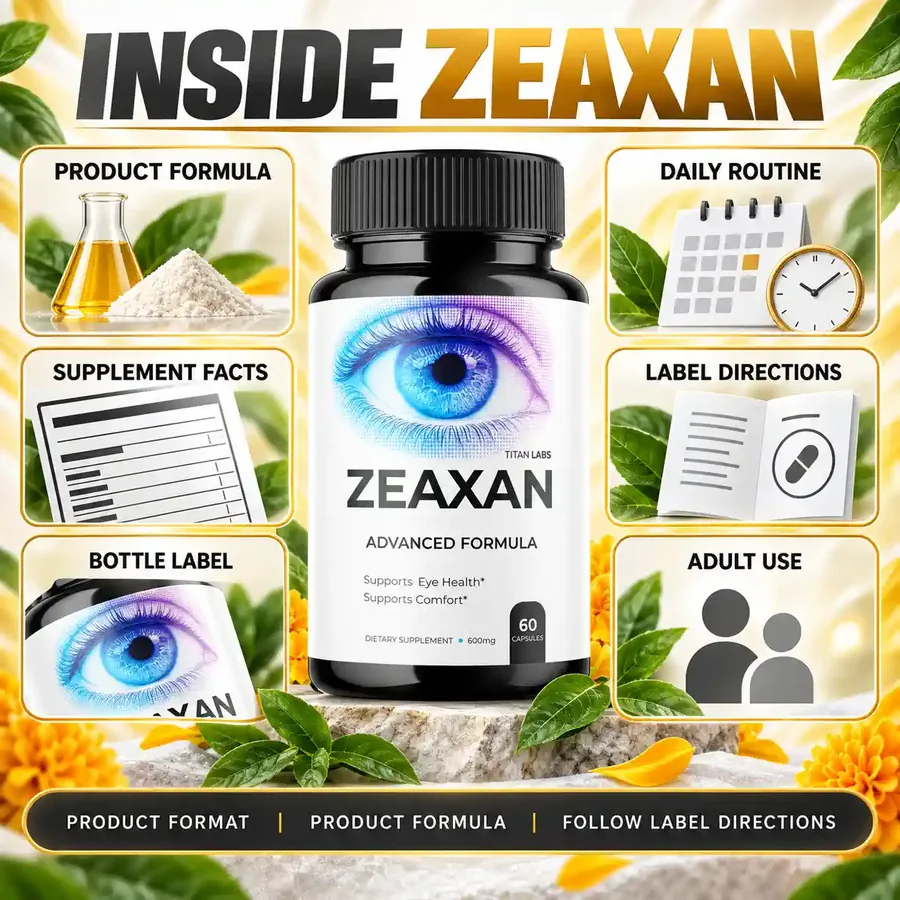
- Rice flour: a filler that keeps each capsule the same weight
- Magnesium stearate: a flow aid that stops powder sticking to machines
- Silica dioxide: keeps the powder from clumping
- Capsule shell: material not stated on the label
A brand panel says Non GMO, 100% Natural, Gluten Free and Made in the USA. Those are brand claims.
Which Zeaxan ingredients are worth raising with a doctor?
Ask a doctor or pharmacist first if you take a daily medicine. Three ingredients may interact with common drugs.
Ginkgo may add to blood thinners such as warfarin, and it matters before surgery (NCCIH, 2025). Cinnamon may add to diabetes medicines. Green tea extract can lower levels of nadolol and atorvastatin, and rare liver injury has been linked to extract capsules (NCCIH, 2025). The side effects page covers each one.
No ingredient here replaces an eye exam. Blurry vision, eye pain, flashes, floaters or any sudden change in sight need an eye doctor, not a supplement.
Zeaxan ingredients: common questions
How much zeaxanthin is in Zeaxan?
The label does not say. Zeaxanthin (5%) is 10th of 11, so it is at most 60 mg of material per serving. If 5% means 5% pure zeaxanthin, that is about 3 mg at most.
Why is salt the first ingredient?
The label does not explain it. Being first means Himalayan pink salt weighs the most of the 11. It is not an eye nutrient.
What is AGP Choline?
It most likely means alpha-GPC, or glycerophosphocholine, a choline source. The label does not spell it out.
Sources for this page
- National Eye Institute. About AREDS and AREDS2. Source
- Kongkeaw C, Dilokthornsakul P, Thanarangsarit P, Limpeanchob N, Scholfield CN. Meta-analysis of randomized controlled trials on cognitive effects of Bacopa monnieri extract. J Ethnopharmacol, 2014. Source
- National Center for Complementary and Integrative Health. Cinnamon: Usefulness and Safety. Updated November 2024. Source
- National Center for Complementary and Integrative Health. Bilberry: Usefulness and Safety. Updated November 2024. Source
- National Center for Complementary and Integrative Health. Ginkgo: Usefulness and Safety. Updated February 2025. Source
- National Center for Complementary and Integrative Health. Green Tea: Usefulness and Safety. Updated February 2025. Source
- NIH Office of Dietary Supplements. Choline: Fact Sheet for Consumers. Source
- NIH Office of Dietary Supplements. Vitamin B6: Fact Sheet for Consumers. Updated June 2023. Source
- NIH Office of Dietary Supplements. Vitamin B12: Fact Sheet for Consumers. Source
- NIH Office of Dietary Supplements. Dietary Supplements: What You Need to Know. Source
- EFSA Panel on Food Additives and Nutrient Sources. Scientific opinion on the safety of green tea catechins. EFSA Journal, 2018. Source
Keep reading
Ready when you are
Order Zeaxan from the authorized US retailer
60 capsules in every bottle, 2 capsules a day. 60-day money-back guarantee. A real person at the order desk handles tracking, changes and refunds; the number is in the footer.